
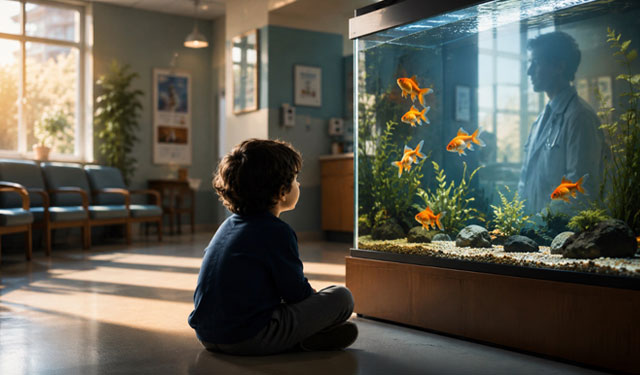
As a child and adolescent psychiatrist, I often find myself wondering what it is like to grow up today. The digital world, increasing academic expectations, and relentless social pressures make it difficult for many children simply to be children. Sometimes, I shamelessly catch myself comparing today’s childhood with my own, assuming life was somehow simpler then. Whether or not that’s true, I often return to one particular childhood memory because it reminds me what peace once felt like—and why so many young people struggle to find it today.
The Wonder That Started It All
When I was six years old, my mother took me to see our local pediatrician. A visit to my pediatrician was not filled with the terror of being stuck with needles. Instead, I thought the aquarium – the massive, glowing glass box, lit from above, filled with vibrant, darting fish. I would spent each visit with my face stood pressed against the glass, completely mesmerized. I would calmly stare while awaiting the front desk to call out my name. In that singular, quiet moment of childhood wonder, my trajectory was set. I decided that if pediatricians got to spend every day with fish like these, then I wanted to become one too!
PHASE 1: THE GOLDFISH
Before the grueling hours of medical school and the heavy armor of professional identity, we all start out as “goldfish.” I now investigate every aquarium and imagine the stages of my life. My imagination led me to reading the Growfused online article from December 28, 2023, titled “Diving Deep into Character: Understanding Fish-Inspired Personality Archetypes”. As a child with dreams of becoming a pediatrician, I was filled with wonder and excitement and took in all of my experiences with my pediatrician with awe. I was that goldfish – “tranquil”, “mindful”, and “observant”. Throughout my primary and secondary education, I just watched everything that had to do with the medical field in amazement. Any television show or movie that was connected to medicine quickly caught my attention and led me to put myself in the scene. Feeling safe, there is no cynicism, no hyper-vigilance, and no fear of making a mistake – simply moments of pure magic of science and the calling to care. Unfortunately, college and medical school can make things more real, and the first shift happens.
PHASE 2: SALMON
Before graduating high school, some of my friends were dealing with mental health challenges, and the conversations around their mental health were intriguing. Sitting and listening to someone to understand how their mind works was thrilling. For you, that thrill may have happened later – in college, in medical school, during your intern year. Maybe it was understanding the lungs that was exciting, witnessing the chaos of the emergency room was fun, or hearing a surgeon talk about his or her cases was amazing. For all of us, this SHIFT leads one to be more focused and determined to become a physician in a specific field. The Fish-Inspired Personality Archetypes that connected to this phase was the salmon, with “unwavering determination, deep-seated resilience, and calculated goal-orientation”. You now must strategically focus on how to become that physician to get to the dream that you can see so clearly. The only way to get these is to be perfect at everything! The laser-like focus is thought to be a great attribute and could only have positive outcome. But then one becomes the shark.
PHASE 3: SHARK
The previous shift of the salmon becomes more intense. The salmon swims upstream, traveling long distances and pushing past all the challenges, for survival of their species. The future doctor also has pushed past all the obstacles to be a stronger in determination and resilience to become that well-respected, spectacular doctor. The goal was to be perfect…and that is the root of the physician perfectionism! It started with the perfect score in school to the perfect supervision rating. The perfect doctor is next…but at what cost? Your connection with friends is lost, what you do for fun is lost, and then…your identity is lost. Luckily, my friends and family were understanding when they saw those empty seats. The birthday party for my sister – “I have an important exam”. The wedding for my friend from college – “I have to be there for my patients”. The funeral for my grandmother from England – “I understand that you cannot afford that trip, and we are going anyway”. That was the remark from my sister who became my talking head. The Shark “naturally assumes control, exhibiting a strong and influential presence in various scenarios”. For some, this intense focus can be positive. But there is a dark side. If you try to control the environment, you show little appreciation for others in it. Becoming a doctor can be like the military or a fraternity/sorority. Nothing gets in the way of the “brotherhood”. Initially, this is excused as others normalize this behavior until there is something you cannot control. The pursuit of becoming the perfect doctor overtime comes with a price that few of us recognize while we’re paying it.
Losing Control
Medical school taught me how to diagnose illness. Residency taught me resilience. But neither taught me how to remain fully human while becoming a doctor. When you realize that you are not an island and you need to work with others instead of CONTROLLING others, that is when doctors become great. Many of us hiding behind our professional armor feel isolated in this struggle, unaware of the power found in peer support for physicians or the safety of anonymous support groups for doctors. The next part of the journey was the hardest for me and may have been the hardest for you. It is, however, the most rewarding. Stay Tuned for Part 2!