It was 2020 – a year that changed all of us! You may remember it as the year of COVID, but that is not what made that year life-changing for me. 2020 was the year that was designated for the most important role of my life – being a father! My daughter was born in the midst of the twin pandemics of systemic racism and COVID-19. The obstacles did not end there – this was all occurring in the midst of my first attending job out of fellowship. As I reflect on these eye-opening years in my life, I also reflect on the lessons they taught me, in hopes that you can connect with them and learn along with me. These lessons are still lessons that I have continued to learn as a physician father even today.
I HAVE TO DO EVERYTHING!
Once my daughter was born, I was still working at a local hospital as the chief attending of an adolescent unit. I was excited about the job and wanted to work hard to make sure that I was doing everything right. Organizing my day, organizing my notes, and organizing my time – all important….and all failing! As the head breadwinner of the family, I felt the financial pressures of being a new father and taking care of the family.
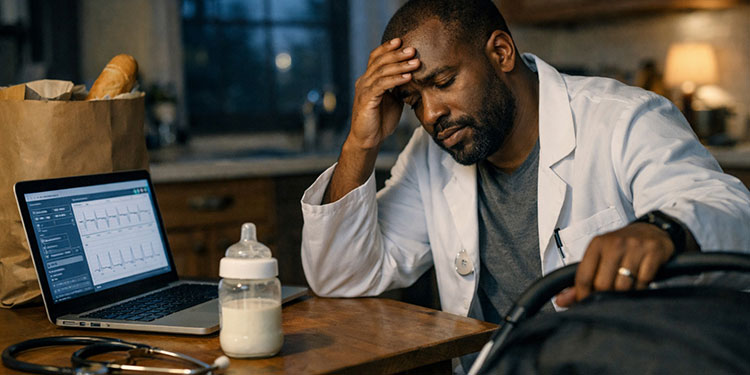
Most people are able to rely on family members, friends, and babysitters to provide some much-needed respite and relaxation from all the necessary challenges of physician fatherhood. In this time of COVID, contact with others had to be minimized. So, for many days after work, I would travel to work. Then, in the late afternoon, I would travel to the grocery store, followed by attending to our newborn and her healing mother. Like so many doctors, I powered through it and made sure that everything was done perfectly. In the meantime, I was becoming exhausted, drained, and not fully present…I was becoming overwhelmed! This was burnout!
Lesson 1: You are not alone!
In the days of COVID, out of safety, we had to isolate ourselves. That isolation, though, came at a cost. Former United States Surgeon General Vivek H. Murthy wrote an advisory report on the importance of social connection and support. As doctors, we have thrived on understanding and proving everything ourselves. Doctors have been trained to do everything under their own power. Burnout is caused by having too much to do on your own and a lack of support. So many doctors learn this lesson late or don’t learn it at all! It is not worth it! Don’t struggle alone… surrender to the help.
I WAS LATE….AGAIN!
Once again, 2020 was a tough year. That new job filled me with great joy and purpose. I was looking not only to do well in this job, but also to find mentors. One of them was my director of psychiatry at the local hospital. There continued to be a drive in me to make things better, and that drive started when I was young. There was no way that I could make my hospital better without understanding the system.
The director wanted to support us new doctors any way she could, and I advocated for meeting her once a month to gain her wisdom. For the first 3 meetings, I was on time and eager to learn. Then, my need to do perfectly caught up with me. I would stay in the hospital to finish up notes, and still had to finish at home. The travel home was filled with thoughts in my head of all the duties that had yet to be completed. The next day, I would be exhausted due to lack of sleep and do it all again the following day. Hurriedly, I would see all my patients with a very tired mind. And then it happened…I forgot about the meeting. Then, I came late to the next one…and then missed the next one!
Overwhelmed by my personal expectations, the director was very concerned about the absences. I got a call … it was a medical director whom the psychiatry director called in for support. After a candid discussion, I once again had to surrender in defeat. He figured me out…I was burned out! It was time to admit that I could not do everything perfectly, and I had to figure out some new organizational strategies. With some help from IT and an executive coach, there was a change in mindset that led to changes in my work…and my life.
Lesson 2: Perfection leads to perspiration
We have been trained not to make mistakes. We have been trained to study when we don’t understand something. We have been trained to do the best for every patient’s well-being. This leads to striving to be perfect, but at what cost? Perfection does not lead to improvement; it leads to stress. That stress will lead to sweating over every small problem.
For those who are fans of Physicians Anonymous, a previous blog post commented that “Physician perfectionism and burnout are inextricably linked…Perfectionism in medicine is, in fact, an unhealthy delusion that fuels not just burnout but mental illness and suicide in doctors.”
Think about the blog post’s story of Dr. Sarah Thompson – “striving for excellence did not mean she had to be flawless.” When you are wearing the two hats of clinician and parent, mistakes will happen. You must have some self-compassion and understand that balancing these two life-saving, life-changing, and life-serving roles is not easy to do. Don’t stress over those mistakes; instead, learn from them.
Conclusion
For me, 2020 was the year of striving at the cost of mental and physical exhaustion. As a physician right out of training, I wanted to do my best to show that I am a great doctor. Proving myself should not have been my goal. Instead, it should have been to strive for stability, not perfection. I wish that I had taken my first year slowly to organize and prepare myself for my long-term career. Don’t make the same mistakes I did. Work towards a mindset of being “good enough”, not perfect. Having to create the space for being a physician father led me done the difficult path away from being the “perfect doctor”. The hardest lesson was learning that it was not important to be the “perfect parent.”